
Pulse
Organizational alignment intelligence for nonprofits, business teams, and schools.
Visit pulseconnect.us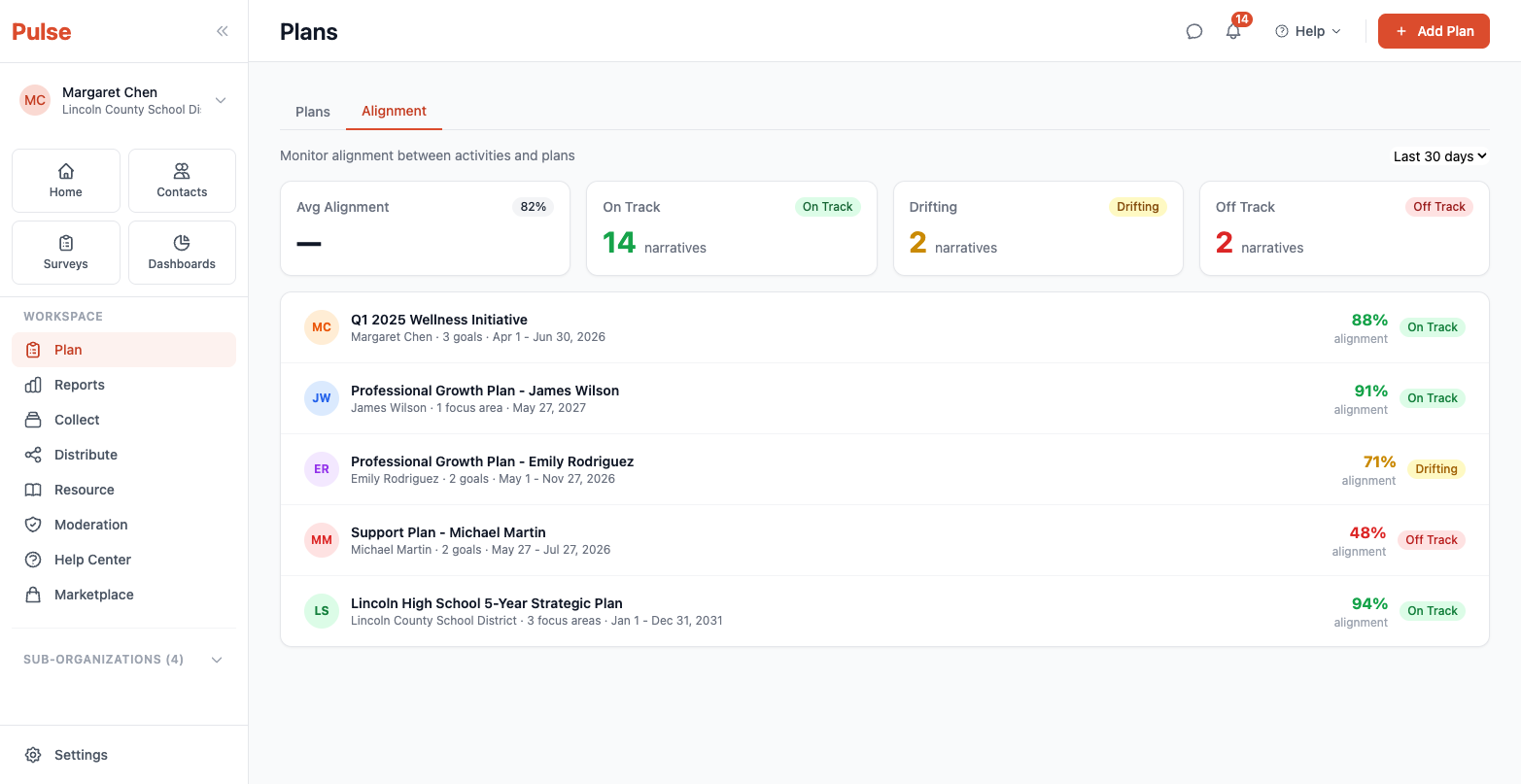
The challenge
Organizations have plans. They have no reliable way to know whether their teams are actually executing them.
Task-tracking tells you what got done. Engagement surveys tell you how people feel. Neither tells you whether the people responsible for executing the plan have a clear enough model of it to make sound decisions in the field. That gap exists across nonprofits, schools, and growth-stage businesses, and no category of tool was built for it.
Pulse started with a nonprofit client whose reporting infrastructure was designed entirely for funders, not for the program directors who had to implement the strategy. Discovery revealed the same structural problem in K-12 schools, corporate teams, and mission-driven businesses. The brief was wrong. The real problem was bigger.
What was built
An alignment intelligence platform serving three verticals.
Nonprofits
Executive directors and program directors managing strategic plans across distributed teams.
Business
Chiefs of Staff, VPs of Strategy, and GMs carrying plans that teams have to execute without the leader in every room.
Education
Principals and heads of school with improvement plans that need to land with teachers and instructional staff.
Pulse measures the gap between strategic intent and team experience. Not how people feel. Not what tasks are complete. Whether the people responsible for execution have a clear enough model of the direction to make good judgment calls in the field, without the leader in the room.
The process
Discovery
The client came in asking for better funder reporting. Fulcrum's discovery process surfaced the real problem: the reporting architecture was built entirely for external audiences, which meant the organization had no reliable mechanism to know whether its own people understood the strategy they were supposed to be executing. That gap, it turned out, was not unique to this client.
Brief evolution
The brief shifted from a reporting problem to a measurement problem, and then from a measurement problem to an infrastructure problem. Once the same structural gap appeared across nonprofits, K-12 improvement planning, and business strategy cycles, the scope expanded to a multi-vertical platform built around a single question: does the organization have the internal visibility to execute what it says it believes?
Architecture decisions
The platform was designed around what Fulcrum calls Trust Architecture: data flows laterally across teams, not just upward to leadership, and the system surfaces pattern-level visibility rather than individual performance data. That philosophy was non-negotiable because the problem being solved required candor from the people filling in the data, and individual surveillance kills candor. The three gap categories Pulse fills were mapped deliberately: Envisio tracks plan progress, Culture Amp tracks sentiment, and Pulse tracks comprehension and belief, which neither tool touches.
What the build revealed
Building across three verticals from the start forced the team to separate what was universal about the alignment gap from what was sector-specific, and that distinction shaped the data model in ways a single-vertical build would not have surfaced until much later.
At a glance
Category
Organizational Intelligence SaaS
Verticals
Nonprofits, Business, K–12 Education
Ownership
Fulcrum-incubated, independently operated
Stage
Accepting founding pilot organizations
From the knowledge library
Ready to see it live?
Now accepting founding pilot organizations.